A Romantic Adventure-Tale of Treasure and Archaeology

You know how you start googling for information on one thing but end up going down a completely different rabbit hole from the one you started on? This happened to me over the weekend and I found myself looking for more information on a story I came across while looking for something else entirely.

It all started this past weekend when I was watching Hondo, starring John Wayne and Ward Bond on cable. This is the story of the Army scout (Wayne) who comes across a soon-to-be-widowed woman (John Wayne shoots her husband) in West Texas who is under the protection of Victorio, the Apache chief.

Victorio was a real person, even if the widow and her new-found lover and his pissed off dog weren’t. So I got to wondering how much of the Hondo story was based on fact, etc….

Long story short: I started googling for Victorio and his battles and then started looking for Victorio Peak, which was supposed to be in the Diablo Mountains region near Van Horn, Texas. I used to live out that way, so when Google Earth pointed me to a place in White Sands, NM near Almagordo, I was initially confused. Turns out there are two Victorio Peaks. One in Texas and another about a hundred or so miles away in New Mexico.

And its the one in New Mexico, far from the place Victorio staged his last battle, that is possibly the more interesting!

In the links at the conclusion of this post[1][2], you can read a couple of articles posted on the web that go into more detail, and I encourage you to read them. I’m not saying the stories are true, mind you. But they were both captivating reads!

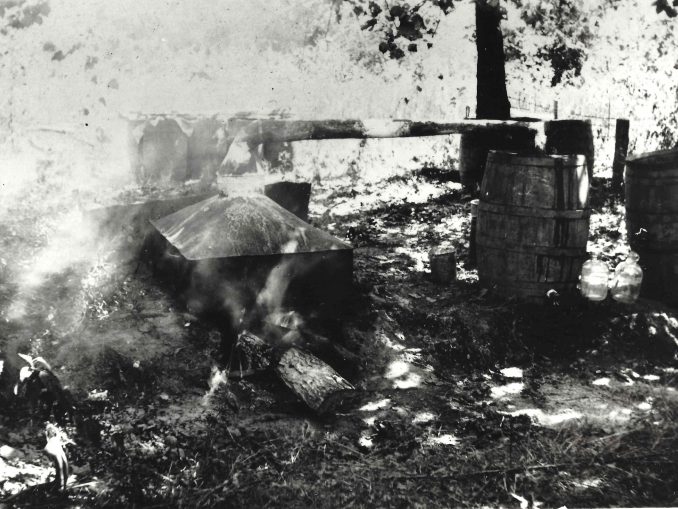
Doc and Babe in the 1930s

The story could begin in the mid-1800s with the battles of Victorio, an Apache chief (and, arguably, in charge of Homeland Security at the time). But that’s a story for another time (I’ve been pondering what an archaeological survey of these battles might consist of).

Instead, I give you Milton Ernest “Doc” Noss and his eventually estranged wife Ova “Babe” Beckworth.

Doc and Babe

They were a handsome couple. Doc was a “foot doctor” (no record of sort of medical degree, however) and he and Babe lived in Hot Springs, now known as Truth or Consequences, NM.  One November day in 1937, Doc and Babe were part of a hunting party that camped near Victorio Peak. While ducking under a rock overhang to escape a light drizzle of rain, Doc discovered an entrance to a cave that had been covered by a stone. Thinking at first that he’d stumbled on an abandoned mine shaft, Doc and Babe kept the discovery under their collective hats, returning several days later with ropes and flashlights. What they allegedly discovered is straight out of an Indiana Jones story!

At the bottom of the narrow shaft was a chamber about the size of a small room with drawings around the walls. Doc thought these sketches were made by Indians, as they were crude and stick-like. Some were painted, while others were chiseled into the rock face. At the other end of the chamber, the shaft continued sloping downward. Descending another hundred and twenty feet before it leveled off, Doc found that the passageway emptied into a huge, natural cavern large enough “for a freight train to pass through.” He saw several smaller rooms chiseled from the rock along one wall.

As Doc inched his way across the great cavern, he made a terrifying discovery…a human skeleton. The hands were bound behind the back, and the skeleton was kneeling, securely tied to a stake driven into the ground, as if the person had been deliberately left there to die. Before leaving the room, he found more skeletons, most of them bound and secured to stakes like the first. Some skeletons were found stacked in a small enclosure, as if in a burial chamber. All told, he reportedly found twenty-seven human skeletons in the caverns of the mountain.

As Doc explored the side caverns of Victorio Peak, he found amazing riches amounting to extreme wealth by today’s standards. Jewels, coins, saddles, and priceless artifacts were everywhere, including a gold statue of the Virgin Mary. In one chamber, he found an old Wells Fargo box and leather pouches neatly stacked to the ceiling.

And gold bars. Lots of them.

Noss Treasure?

The Noss Treasure?

Keep in mind, this was the 1930s. Franklin D. Roosevelt had just signed Executive Order 6102 in 1933, which forbade U.S. citizens from “Hoarding of Gold Coin, Gold Bullion, and Gold Certificates.” So, assuming the story of his find is true, what was old Doc supposed to do? From the stories I’ve read of Doc Noss, he was a bit of a shady character -a wheeler and a dealer. He allegedly brought up a bar or two at a time, smuggled them to Mexico and sold them on the black market at a price far below their worth.

What’s the Theory?

There are a lot of “theories” to explain Doc Noss’ treasure. Some think it was the Casa del Cueva de Oro, Spanish for the House of the Golden Cave, and was a cache of wealth established by Don Juan de Onate in the 16th century. Others think Noss may have chanced upon the treasure of Felipe La Rue, a 18th century French priest that was in search of riches he’d heard in stories and that he established a wealthy gold mine there in the Hembrillo Basin where Victorio Peak, once known as Soledad Peak, is. The peak was renamed in honor of Victorio, who used the site for a stronghold and stood off U.S. Army soldiers in the 19th century.

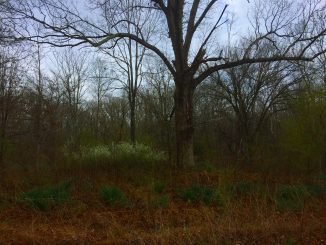
Victorio Peak

Victorio Peak

But did Doc and Babe Noss really find a cache of wealth in the 20th century?

This is where the story has a twist. Doc had filed a claim on the site for prospecting by the end of the 30s but ended up collapsing the entrance in a attempt to blast a wider entrance. He had a few hundred bars brought to the surface by now, but Executive Oder 6102 was still in effect, so his desperation for cash put him in a dilemma.  In 1949, 12 years after his alleged discovery, Doc Noss was shot in the head by a “business associate,” apparently wanting his gold.

But it doesn’t end there. In 1951, the U.S. Army, somewhat evolved from the days when it chased Victorio, annexed the land that Victorio Peak sits on as part of the White Sands Missile Range. This is the period following World War II where we were now in a nuclear arms race and White Sands was where much of the nuclear weapons were being tested. Babe fought for decades to work her inherited claim, but the Army had full control of the surface of the land.

What follows are a few tales of conspiracy and intrigue. Even an airman first class and a captain who apparently found an open fissure and reported seeing gold bars in a cavern. The Army excavated the site using Gaddis Mining Company in 1963 with no results. A member of the Noss family was finally given permission to excavate for two weeks in 1972, but also came up dry.

Victorio Peak

Victorio Peak: Courtesy Google Earth

To this day, the heirs to Babe Noss are still trying to access the site, which is still part of White Sands Missile Range.

My thoughts are that the site was part of an elaborate scam that involved seeding a mine to scam people out of their cash. Still, there’s always that romantic hope that a buried treasure sits there waiting for the right person to discover it. There may or may not have really been a treasure, but the story is ripe for a movie!

Enhanced by Zemanta
Notes:
  1. McGuire, Bonnie (2010). The Treasure of Victorio Peak. http://www.mcguiresplace.net/The%20Treasure%20of%20Victorio%20Peak/ []
  2. Paul, Lee (date unk). The Strange Mystery of Victorio Peak. http://www.theoutlaws.com/gold7.htm []
Posted in Archaeology | Tagged , , , , , , , | 2 Comments

The Pseudoarchaeology of Glenn Beck

It should be no surprise that, since he has little grasp on the rest of reality, that Glenn Beck would fare any better at understanding archaeology.

embedded by Embedded Video

YouTube Direkt

In the first few seconds of that video, Beck gets much wrong. He states that the little square he drew in the Octagon section of the Newark Earthworks (Newark, Ohio) is “made up of staves” which are each 606 feet long. He points to the four corners of these “staves” in his chalkboard diagram to illustrate precisely the four lengths he’s referring to.

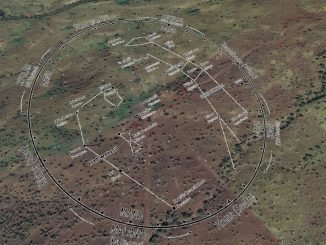
Except his measurements are utterly wrong. And not by just a few feet. The average length of each of his “staves” is about 1,000 feet -nearly 400 feet more than he says. To illustrate this in a diagram that’s somewhat more precise than his chalkboard drawing, I’ve created the following graphic using Google Earth with a KMZ file[1] I borrowed from James Q. Jacobs (thanks, James. Hope you don’t mind).

Newark Earthworks

A true measurement of the Newark Earthworks

The measurements aren’t precise. I didn’t go to the ground and survey the site with a transit. But my margin for error is less than 10 feet. That still leaves 300 feet unaccounted for with Beck’s assessment. The “stave” above measures 1090.39 feet as indicated by the Google Earth ruler.

Next, Beck goes on to describe the angle of the pyramids and how its somehow significant that this angle precisely matches the angle taken from the center of the circular formation when measured against the line bisecting the octagonal formation. These, he claims, are both 51.8 degrees.

They aren’t. He’s closer than with the “staves” argument, however. The angle he shows on his chalkboard (what’s with that thing, anyway?) is one that’s very subjective. If you know what angle you want, you can just about arrive at it simply by moving your radius since the circular earthwork isn’t a perfect circle nor do the two openings perfectly align with the northeast opening of the octagonal formation, as you can see in the diagram above. I placed the center of the circle to be equidistant from the two openings of the circle but inline with the center of the two furthest openings -the southwest (on the circle) and the northeast (on the octagon).

From here, if you draw a line due north (true), which is easy to do in Google Earth, you end up with an angle of 50 degrees (+/- 0.5), which is as much as two full degrees from Beck’s “51.8 degrees” that the Great Pyramid of Giza is. Beck calls this the “exact same calculation,” but it really isn’t. The calculation for the Great Pyramid was arrived at through trial and error. Earlier pyramids had different angles. The Bent Pyramid, for instance, has and angle of 55 degrees until the upper courses, which change to 43 and 44 degrees. 55 degrees was probably too steep and it was probably too costly in manpower and resources to totally scrap the pyramid. By the time Khufu and Khafre built theirs, many lessons had been learned. 51-52 degrees (we no longer have the casing stones to be exactly sure) was ideal since it went up without falling over.

And that’s an important distinction between the “51.8 degrees” of the Giza pyramids and the Newark Earthworks. One is a structure’s angle going up. The other is an angle resulting from an alignment with an 18.6 year lunar cycle[2]. The two have nothing to do with each other and Beck is creating a correlation that doesn’t exist.

So then Beck’s poor grasp of archaeology moves on to moundbuilder pseudoscience, fakes, and forgery that has long been cast aside by scholars. He starts on about the “Newark Holy Stones,” one of which is often referred to as The Decalogue and was alleged to have been found by David Wyrick in 1860. It’s called the “Decalogue” because it depicts a bas relief of a man, ostensibly a priest, with a condensed version of the 10 Commandments inscribed in a crude form of Hebrew. Another stone is the “Keystone,” named for its shape, which also has Hebrew script.

That these two stones (and others) are fakes and frauds really isn’t in question. The only question is did Wyrick fake them himself or did he have help? Or was he duped by others. The implication by Beck and 19th century believers, was that this was evidence of the so-called “Lost Tribes of Israel” -a motif that Beck, a Mormon, has a lot of investment in. But, if this were evidence of such a “Lost Tribe,” then the script on the alleged artifacts would have been pre-Exilic Hebrew. Instead, the forgers, probably being ignorant of this, used a post-Exilic script[3] .

In the 19th century, there was a prevailing myth of a “Moundbuilder society” that somehow vanished. This often became twisted into the agendas of certain religious and political causes but the credit couldn’t possibly go to the Native Americans. To recognize these people as the rightful designers and builders of such magnificent and detailed constructions would mean admitting that the Native Americans were something more than the “savages” and “heathens” they were characterized and marginalized as. Such characterizations made it far easier to force them off their lands, displace them, and treat them as less than white.

Fortunately, such beliefs and agendas have been forced out of academia early on by the likes of Cyrus Thomas, who had a Federal Government budget to find out the truth of the Moundbuilder mystery. His work was empirical and it concluded that the mounds “were built by the Indians.” In addition, he had the occasion to debunk some of the “tablets” that were cropping up here and there, including the Davenport tablet to which he launched a full, empirical investigation that discovered that it had been planted recently (to 1894) in a mound in Davenport, Iowa[4].

The stones and tablets Beck presented are frauds. Beck is a fraud.

Enhanced by Zemanta
Notes:
  1. http://www.jqjacobs.net/archaeo/sites/newark.kmz []
  2. Lepper, Bradley T. Feb. 13, 2007. Octagon Earthworks’ alignment with moon likely is no accident []
  3. Deal, David A. (1996). “The Ohio Decalog: A Case of Fraudulent Archaeology,” Ancient American, #11 []
  4. Feder, Kenneth L. Frauds, Myths, and Mysteries: Science and Pseudoscience in Archaeology Mayfield Publishing Company 1990 3rd ed []
Posted in Pseudoarchaeology | Tagged , | 8 Comments

Four Stone Hearth 99 is Up

At A Very Remote Period Indeed! And its the last double-digit edition! Next time around is #100 hosted by Martin at Aardvarchaeology. So send him your submissions. Don’t forget! I got lucky this time around and Julian picked up on my recent post on John the alleged Baptist!

Posted in Blogging | Leave a comment

The Pseudoarchaeology of Saint John the Baptist

Head of Saint John the Baptist on a plate, a s...
Image via Wikipedia

Yet another example of religiously (and probably nationalistically) motivated pseudoarchaeology has emerged in the news. A Bulgarian archaeologist and at least one overly nationalistic politician with a bad mouth claim to have discovered the remains of Saint John the Baptist in a small reliquary made of alabaster found under the basilica of an ancient monastery.

The remains include a few small cranial, dental, and other bone portions identified as from a hand. On the reliquary, a container that especially designed for “holy” relics, is an inscription which includes, “Sveti Ivan,” which means “Saint John,” along with the date June 24, a day traditionally considered as St. John’s birthday.

Thats it. That’s all the evidence apparently necessary for archaeologist Kazimir Popkonstantinov and Minister Bozhidar Dimitrov to safely conclude that they have, indeed, found the mortal remains of Saint John the Baptist.

Never mind that relic fraud was a very, very common practice in antiquity. Never mind the stories of Saint John’s death and distribution of his remains are inconsistent with what is claimed to be found. Never mind that it appears to be in the best interests of a certain nationalist politician to have a sensational find.

Perhaps this is the remains of John the Baptist. And my natural skepticism of religious claims on reality isn’t the reason I make the accusation of pseudoscience. Its the rush to conclusion and the sensationalist propaganda that gives the unwary public of Bulgaria (and the world) the impression that archaeology is being done -proper, scientific archaeology. When, in fact, quite the opposite is happening. We already know that early churches (as well as modern ones!) are willing to claim possession of of relics that belong to demigods and sub-deities they refer to as “saints” in order to motivate and inspire their tithing memberships. We already have examples of medieval frauds that have been used in this way (the shroud of Turin, for example).

What we don’t have are strontium analyses of these bones, which might reveal whether or not the individual traveled the Near East in the same places as John were alleged to. Or comparisons of the bones to determine if they are even of the same individual. Or of the same sex as John! There aren’t even any radiocarbon dates of the remains that I’ve been able to locate.

But even a simple literary review would reveal some problems with either the remains or what is believed known of John. The cranial remains and post-cranial remains, by legend, are to have been separated. Yet the reliquary has remains that are both cranial and post-cranial. If any of the remains belong to John, then either some do not or what is believed “known” about the man is wrong.

Enhanced by Zemanta
Posted in Pseudoarchaeology | Tagged , , , , , , | 2 Comments

Now the dust is starting to clear…

I’ve sorted out some of the behind the scenes woes with the WP 3.0 upgrade. They actually put out an update last night to 3.0.1 and that upgrade went smoothly… without the Internal Server Error 500 I was getting previously. It took a little editing of the .htaccess file. Perhaps I’ll blog on the upgrades and improvements for the benefit of others who are thinking of the WP upgrade to their own blogs.

And the Articles Page is back!

Oh… and I’ll get rid of that silly sunset soon. I’m trying to work out a nice little banner.

Enhanced by Zemanta
Posted in Blogging | Tagged , , , , , , , | Leave a comment

4,000 year-old brain surgery?

An archaeologist from from Ankara University, Fikri Kulakolu, reports the discovery of a 4,000 year old skeletonwhich has evidence of “a successful brain operation” in which the patient survived.

This sort of trephination isn’t unheard of in the ancient world, but it’s probably the oldest example of medically purposed trephination that I’ve heard of. Still, it isn’t too big a stretch to imagine that it might have been done. The technology wouldn’t have needed to be more complex than a sharp stone. The understanding that such an operation might be beneficial can seem to be a stretch of imagination, but it speaks to the cognitive ability of humanity.

We see ourselves as existing within our heads. Not our feet, stomach, or even our chest -but behind the two eyes and between the two ears that we use to sense the world around us. Perhaps the first person to be trephined this way in this Assyrian tradesman’s culture was done so in an effort to remove a foreign object, behind which cerebral fluid collected (what we would, today, call a subdural hematoma). Patients suffering a hematoma show almost immediate improvement with draining, so all it would take is a single observation to make a connection that a local “healer” can exploit.

Brain injuries that result in subdural hematoma are also frequently accompanied by seizures. So it isn’t improbable that the connection between seizures and built up fluid would be made. This might explain evidence of trephinations where obvious injuries aren’t present in the cranial remains. But then it might also be that the injured bone was removed, leaving no evidence of the injury itself.

Enhanced by Zemanta
Posted in Archaeology | Tagged , , , , , , , | 1 Comment

Dead Sea Scrolls: were the authors Jewish or Jewish?

Qumran Cave 1 - Dead Sea Scrolls
Image by Randall Niles via Flickr

The Dead Sea Scrolls were discovered in 1947 caves near Qumran on the Dead Sea by a Bedouin shepherd. Stored for nearly 2 millennia in clay jars or pots, the scrolls survived with the help of the dry climate and have been the subject of intense study and research, mostly by biblical scholars, over the last few decades.

The conclusion has long been that the scrolls were written by a Jewish cult from Qumran known as the Essenes, who practiced their traditions between the 2nd century BCE to about the 1st century CE. This conclusion is based on many things, such as the proximity of the scroll caves to Qumran where the cult was based, the dating of the scrolls themselves, Essene customs (eg. ritual bathing) included in the scrolls, and the general congruity and thematic connection between the scrolls themselves.

On a recent National Geographic documentary, Writing the Dead Sea Scrolls, which featured “biblical archaeologist” Robert Cargill, Cargill suggests that the scrolls were written by multiple Jewish sects and that all or, at least some, of the scrolls may have originated from the Temple in Jerusalem, which legend says was under siege by the Romans around 70 CE.

One of the key pieces of evidence that Cargill cites is a recently deciphered inscription, “Lord I have returned,” found on the sides of a 2,000 year old cup. The code used on the cup is similar to that used in the Dead Sea Scrolls.

From this, Cargill seemed to conclude that the Essenes were once a part of the priestly class at the Temple in Jerusalem. I have to admit that the presentation was one in which the opinions of several scholars were drawn from, but I got the distinct impression that Cargill was in agreement with the multiple origins of the scrolls, particularly with the Temple origin. I’m going to re-watch the program, however.

While it’s possible and holds a certain level of probability, it still doesn’t explain the overall congruity of the Dead Sea scrolls, the fact that the Essenes were well-established in Qumran prior to 70 CE, and the lack of incongruent scrolls that one might expect if suddenly a group of fleeing priests were to appear in Qumran with texts they sought to preserve. I find it more likely that the Essenes were in limited contact with the outside world, at least for trading certain goods if not sharing academic and cult knowledge. This would explain the use of clay pottery from other regions.

It might even explain why a similar code appears elsewhere. Perhaps this practice of “coding” texts from non-priestly readers was adopted by the Essenes by sources that were ancestral to both the Essenes and the Temple Priests. Perhaps an Essene traveled to the Temple and left his cup, either through trade or accident. Perhaps a Temple Priest traveled to Qumran and obtained a cup as a gift. Perhaps…

I think it would be interesting if there were a way to show that fleeing priests from the Temple in Jerusalem arrived in Qumran with the Essenes. But I just don’t see that there’s enough evidence to arrive at that conclusion. I recognize, however, that archaeology surrounding mythical places like the Temple are important to “biblical archaeologists” and such reinforcement is a powerful psychological benefit to those who are invested in the religious beliefs that surround the myth of the site.

And, just to clarify, I use the term “myth” not to imply that the Temple didn’t exist. Rather, that there is a set of beliefs in a “power” surrounding the site that is, itself, mythical and not based in reality.

Enhanced by Zemanta
Posted in Archaeology | Leave a comment

Okay… a little sawdust here and there…

Air University Library's Index to Military Per...
Image via Wikipedia

I’ve been working on the blog behind the scenes the last few days where I can get an hour or so from work and sleep. The theme looks pretty plain-jane right now, but its the new “Twenty Ten” theme, which is supposed to “take full advantage of WP 3.0.” The jury’s still out on that one.

It all started innocently enough. I thought I might simply do an auto-update. But that wouldn’t work. So I thought, hey… why don’t I just ftp the new files over after a backup?

That’s when I found out that I would need MySQL 5+ for a database rather than the much earlier version I had.

Okay… then I figured I’d simply update the database after a backup. Right? Right.

Turns out my webhost has a limit of just under 3 MB for an SQL database import. Mine was over 80 MB.

But, after doing some copy/paste jobs from the old database tables to the new database via queries, I have it mostly up to date. I’m not sure I’ll go back to the previous theme or just tweak this one, I haven’t figured out what the enhancements truly are yet. But I need to repair some image links and some miscellaneous formatting here and there. I can’t seem to get my Amazon widget working. And the silly characters that litter old posts when the database was updated will probably just have to stay. It seems special characters, inverted commas and apostrophes don’t import very well.

Ah well….. bear with me. :-)

Enhanced by Zemanta
Posted in Blogging | Tagged , , , , | 2 Comments

The Pseudoscience of Homeopathy

I am not responsible for any keyboards for those who tried reading this with their morning hot cup of joe!

If you’ve never visited xkcd, you should!

Enhanced by Zemanta
Posted in Archaeology, Skepticism and Pseudoscience | Tagged , , , , , , , | 1 Comment

Twitter Weekly Updates for 2010-07-09

Powered by Twitter Tools

Posted in Blogging | Tagged , , | Leave a comment