Three cool things about archaeologist Larry Zimmerman

1) Archaeology of Homelessness: Zimmerman, along with student Jessica Welch, recently presented the findings of a study they completed which examined the material culture of the homeless.The presentation was at the World Archaeological Congress in Dublin, Ireland. The study was conducted near downtown Indianapolis.

What they found was that they can derive new information about the problem of homelessness, a contemporary issue in most cities in the world by applying archaeological methods to sites where the homeless congregated. From this information, Zimmerman posits that “[a]rchaeology can be a tool for making decisions, not just for understanding the past.”

“We found a large number of food cans. Most had been opened, often not very successfully, with knives or by banging them against rocks or even by heating them until the contents exploded. We rarely found cans that had been opened by a can opener. That made us realize that they didn’t have can openers, which must have been very frustrating to them,” said Zimmerman.

2) 2008 Peter Ucko Memorial Award. Zimmerman wasn’t just in Dublin to present his findings on the archaeology of homelessness. While there, he received this award for his contributions to modern archaeology due largely, perhaps, to his work in Native American archaeology and the sensitivity and understanding with which he has approached archaeology.

The award is named after Peter Ucko, the founder of the World Archaeological Congress and “a British archaeologist who broke with tradition during the 1980s by instituting the participation of indigenous communities as part of the proper scope of archaeology.” Zimmerman was nominated by four Native archaeologists, including Dorothy Lippert, a Choctaw and archaeologist with the Smithsonian Repatiration Office at the National Museum of Ntural History.

“The award was very humbling, and it was gratifying to be recognized, but I have to admit that I can make no claim to planning much of what happened,” Zimmerman said modestly. “One of the best things to come from my work and that of other non-Indian archaeologists is that we helped younger Indian students understand that there were archaeologists who cared about more than science, that you could be an archaeologist and still be respectful of traditions. It’s nice to know I had a role in that.”

3) Presenting the Past (The Archaeologist’s Toolkit, V. 7). I read this book a couple of years ago and it really inspired me. One of the things I feel passionate about is presenting science, particularly archaeology and anthropology, to the public.

In this book, Zimmerman outlines the need to present archaeology to the public as well as how it can be done. Chapters include: Recognizing our Audiences, Choosing the Right Medium, Computers and Presenting the Past, Visual Archaeology, and From Presented to Printed among others. If you’re an archaeologist and interested in presenting archaeology (or any science) to the public, then there will be something in Presenting the Past for you.

[W]e … need to learn that archaeology can be a very cruel discinpline. Like hisotry, archeology can literally undercut a people’s belief system. Little wonder that many tradition-oriented American Indians desipise an archeology that sometimes seeks to debunk their origin sotries. The problem, of course, is how to deal with archaeological interpretations about hte past and our kind of “truth” versus a concern for people’s feelings. That is no small matter!

We shouldn’t have to dumb down everything we do so that it “sells” or makes people “feel good” about themselves. Rather, we had better figure out that just doing archaeological reports doesn’t cut it if we want our publics to learn about, let alone buy into, our disciplinary views about the past. Worse, it may even alienate them if done without sensitivity to their concerns or needs.

Stolen & Looted: $5-6 Billion in Stolen Artifacts?

This is part of an on-going series dealing with the theft, sale, and trade of artifacts and archaeological finds that are abruptly removed from their contexts, destroying valuable data that can be gleaned and sold to the highest bidder for profit at the expense of ever improving our understanding of cultural heritage and history.

reporter for Macon.com (Macon, GA) writes a fascinating article on the stolen artifacts market that suggests that the monetary gain of trafficking in illegal artifacts is significantly higher than even I would have thought.

She begins by describing the efforts of a a special investigator for the Georgia state Department of Natural Resources who was dealing in illegal goods. Initially, the investigation was about illegal wildlife products but it eventually encompassed guns and drugs then ancient human remains.

Duncan’s article is worth reading, particularly if you’ve never considered the impact looters have on cultural resources in the United States.

She discusses the legal issues of looting in the state of Georgia:

With written permission from the landowner, it’s legal to search for artifacts on private land in Georgia. But digging archaeological sites without permission, or on state and federal land, is illegal. On federal land, such as the Ocmulgee National Monument or Oconee National Forest, it can be prosecuted as a felony. And the penalties only get worse if burials are involved.

And a sidebar to the article goes into detail with regard to Georgia state and federal laws.

Another interesting part of her article reveals the damage looters have done to several mound sites in Georgia, including the nation’s only spiral mound, where looters have broken through fences and dug holes in the mounds to remove artifacts for subsequent sale.

Duncan cites Rick Kanaski, a regional archaeologist and historic preservation officer for the U.S. Fish & Wildlife Service who points out that there are three types of looters:

  1. Solo diggers collecting for themselves
  2. history buffs involved in larger trading networks, and
  3. those involved in criminal networks, who may cash in artifacts for drug money

Apparently the third type is a significant player in the trade of stolen artifacts. “I can’t tell you how many calls I’ve gotten from sheriff’s departments asking why they find what they call ‘Indian rocks’ when they bust meth labs,” said Charles Louke of the Dept. of Homeland Security. This, it would seem, is why he claims stolen artifacts trade amounts to between $5-6 billion industry.

Further Reading:

Tomb raiding: illegal artifacts trafficking is a $5 billion to $6 billion business. [Macon.com]

Don’t forget the Four Stone Hearth

Wednesday, August 27, 2008 will mark the next edition of the Four Stone Hearth which will be hosted at Tangled Up in Blue Guy. This is his first time hosting the FSH, so give him your support and send some cool stuff.

The next slot was vacant, so I sent Martin an email volunteering for it. I figure that’ll be a good housewarming party for the new digs here at my own domain.

Hmmm…. I might just have a theme there….

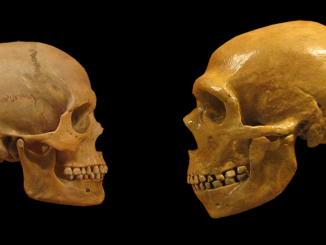
Neanderthals were not stupid

Neanderthals probably weren't stupid

Neanderthals probably weren't stupid

It has long been thought that one of the reason Homo sapiens eventually dominated the hominid line, colonizing Africa and Europe beginning at around 40,000 years ago and eradicating or out-competing the Neanderthals, was that they were technologically advantaged. The idea was that because H. sapiens had better stone tool technologies, they had the edge, so to speak, on their Neanderthal cousins who already occupied the lands H. sapiens were migrating into.

This sort of explanation, perhaps, is easily believed whether one wants to accept it or not since H. sapiens are us and we do, after all, have a not-so-proud history of simply taking the lands we need from those less advanced or capable.

The Dim-Witted Cave Man?

I ♥ My ♣

I ♥ My ♣

It’s also been a common preconception that Neanderthals = “cave men,” which carries the cultural connotation of being stupid or of diminished wit, bringing to mind the humorous television commercials produced by Geico and the thousands of magazine and newspaper cartoons over the years that depicted cave men in various antics, the most prevalent theme being, perhaps, clubbing a cave woman over the head and taking her home.

However, new information has come to light with a study published today in the Journal of Human Evolution in which researchers in experimental archaeology spent three years producing flakes, stone tools created through the process of flintknapping in which cores of stone are shaped through percussion and pressure to manufacture tools like blades, axes, scrapers, and points.

The production of three years worth of flakes and blades, the former used by Neanderthals and the latter by Homo sapiens, allowed the researchers to gather statistical data on the quantities of tools, amounts of produced cutting-edges, durability of cutting-edges, and efficiency of the tools. The empirical data allowed the researchers to conclude that the difference in stone tool technology used by the H. sapiens vs. the Neanderthals offered no technological advantage.

The lead author of the paper in the J. of Human Evolution, Metin Eren of the University of Exeter, remarked:

Our research disputes a major pillar holding up the long-held assumption that Homo sapiens were more advanced than Neanderthals. It is time for archaeologists to start searching for other reasons why Neanderthals became extinct while our ancestors survived. Technologically speaking, there is no clear advantage of one tool over the other. When we think of Neanderthals, we need to stop thinking in terms of ’stupid’ or ‘less advanced’ and more in terms of ‘different.’

The University of Exeter in the U.K. offers the only degree in Experimental Archaeology in the world. The other researchers on the project were from Southern Methodist University and Texas State University as well as the Think Computer Corporation.

I’ve been watching for the article, but it doesn’t seem to have made it to online publication just yet even though it’s slated for today. It’ll be interesting to see just what, specifically, the differences are between cutting edges of flakes versus blades.

Regardless, this sort of research is always great since it eliminates assumptions, which, when wrong, are bad since they lead archaologists down the wrong path. If blade technology wasn’t the clear advantage H. sapiens had over Neanderthals, then the question becomes, “what, then, caused the Neanderthals to go extinct and why were H. sapiens more adapted to deal it? Or could H. sapiens simply not have faced the same pressures at all?”

John Cleese – The Scientist

Four Stone Hearth – past and future

Remote Central hosted the Four Stone Hearth on July 16th and I somehow completely over looked it. Tim always does a great job and if you haven’t read the posts at the blogs he linked to, now’s as good a time as any. Click here to read it.

The next installment of the Four Stone Hearth anthropology carnival will be hosted at Testimony of the Spade on July 30, 2008 -there’s plenty of time left to work up submissions and send them in (you can find Mangus’ email address at the end of his “About” page). If you’re interested in hosting the FSH, drop Martin Rundkvist a line.

Nitrogen Tires part 2

Looking through my spam filter I find the following:

Cfeagans

Hello. You may recall that I posted the below entry on your blog, Hot Cup of Joe, countering some of your arguments against nitrogen tire inflation. I was just curious to know why you decided not to publish it? I was always under the impression that the beauty of blogs was that you could often see differing points of view and readers could make their own determination.

That’s only the first paragraph. What follows is a list of links, which is why Akismet caught it as spam. I’m not convinced that it isn’t. It looks like someone going around all the blogs reposting the same copy/paste propaganda. I’ll probably approve the comment later today, but I want to review it first.

A Classic Paper: Archaeology as Anthropology

This is an entry submitted for The Giant’s Shoulders blog carnival, the “Classic Papers” category.

Binford, Lewis R. (1962) Archaeology as Anthropology American Antiquity, 28 (2), pp. 217-225

Lewis Binford is considered by many to be one of the most influential archaeologists of the 20th century. During his teaching stint at the University of Chicago (1961 to 1965), this paper was published in the journal American Antiquity and helped Binford establish a paradigm that is still used today which is that there is a necessary relationship between anthropology and archaeology. Today, archaeologists refer to this as “processual archaeology” and there are many professors that still teach the “Binfordian” school of thought when approaching archaeological questions. One of Binford’s concerns was always to approach archaeological questions with a scientific perspective.

This paper begins Binford’s passion for arguing a processual method of archaeological research which includes logical positivism and the hypothetico-deductive model, scientific methods that rely on falsification, observation and hypothesis testing. While others before Binford, notably Gordon Willey and Phillip Phillips in 1958, argued that American archaeology is anthropology, Binford takes the idea to task in “Archaeology as Anthropology.”

Binford held that it was one thing to explicate the material record but another thing altogether to explain the material record in detail. For instance, it might be obvious when looking at an archaeological site to observe that at a given period in time a given culture migrated. But to explain the whys and hows of that migration, it requires a more holistic approach to analyzing the artifacts within the site. Indeed, it may require comparing and contrasting with artifacts from other periods or other sites of similar environmental and socio-demographic pressures. From these, Binford asserted, archaeologists can formulate and test hypotheses and make predictions.

For Binford, “undifferentiated” and “unstructured” views of artifacts within the material record were “inadequate” and he called for a “systematic and understandable picture of the total extinct cultural system.” One that incorporates strict scientific methodologies to provide useful data to the explanations of cultural evolution. And he was dead set against merely equating material culture with technology.

Binford proposed three major classes of artifacts and a “category of formal stylistic attributes.” Adapted directly from “Archaeology as Anthropology,” they are:

  1. Technomic artifacts – their primary functional contexts are in coping directly with the environment. Examples are hand axes, adzes, projectile points, fishhooks, etc.
  2. Socio-technic artifacts – material elements having their primary functional context in the social sub-systems of the total cultural system. Examples include a king’s crown, a warrior’s coup stick, etc.
  3. Ideo-technic artifacts – items which signify or symbolize the ideological rationalizations for the social system. Examples would be figures of deities, clan symbols, symbols of natural agencies, etc.
  • Stylistic, formal attributes – qualities that cross-cut the three major classes of artifacts, which serve to provide a sense of “style” and to promote group solidarity and a basis for group awareness and identity. An example of this would be Greek red or black figure motifs, which occur on ceramic vessels with varied functional contexts.

One of the things that makes this such a seminal paper is that Binford not only establishes his assertions and what he believes the future of archaeology should become, but he details why. More than this, he provides a working example of his proposed methods at work by using the Old Copper Complex of the Western Great Lakes as an example.

The Old Copper Complex can be dated as far back as 6000 BCE and, while they initially created copper tools, later assemblages (toward 3000 BCE) reflected a return to stone and bone, with copper being used primarily for symbolic and ornamental functions. This has been cited as a case of “cultural devolution” since it seems counter-intuitive to abandon the superior material of copper as a technology for tools only to return to stone and bone.

However, Binford quite gracefully demonstrates an explanation that goes beyond merely explicating the obvious. He drew upon what was already established as understood by anthropologists about egalitarian societies and their transformations as populations increase, creating more competition for status. He works out for the reader how it is neither efficient nor an economic expenditure of energy to create copper tools without recycling the material. He shows how the culture doesn’t recycle or rework copper tools since so many are found in disrepair in the archaeological record and none appear to be reworked. Moreover, copper goods are almost always found as part of burial goods.

If, Binford asserts, durability were a factor, then some mechanism should have found its way into the society to retain the copper tools rather than dispose of them with the dead. Since this isn’t the case, the conclusion is that they were not considered more durable when compared with stone and bone.

Binford spends several pages on the explanation, which I won’t do. To summarize, he posits that egalitarian societies cherish the achievement of the individual, which allows the individual to gain status among the group. Technomic items of exotic material, painstaking created, and elaborately decorated were considered symbolic of achievement. These status symbols would be personalities and thus subject to disposal at the death of their owners, hence the artifacts found in burial sites.

As populations continued to increase, according to Binford, so did the selective pressures that give individuals a need to communicate status. Differential roles within society emerged, giving rise to the appearance of a new class of socio-technic items, formerly the technomic items. Stone and bone again find their utility and copper is relegated to non-utilitarian functions, such as jewelry.

Lewis Binford’s philosophy of archaeology lives on in the students of his methods. “Binfordian” is a term that most American students of archaeology have probably encountered. Many are very likely to consider themselves to be of the “Binfordian” mold. In other, later, publications, Binford went on to refine and perfect his perspective of processual archaeology, but it’s my opinion that “Archaeology as Anthropology” was the seminal paper that first showed the glimpse of things to come. Reading it today, Binford’s wisdom and the clarity of his words ring clear. There is an objective and knowable past that can be explained if the right methodology is employed. I’ll close this post with the last half of Lewis Binford’s concluding paragraph:

As archaeologists, with the entire span of culture history as our “laboratory,” we cannot afford to keep our theoretical heads buried in the sand. We must shoulder our full share of responsibility within anthropology. Such a change could go far in advancing the filed of archeology specifically, and would certainly advance the general field of anthropology.

Nitrogen Filled Tires: a Scam?

While this is primarily an anthropology and archaeology blog, I also like to write about skeptical topics as well. I’ve written several bits about pseduoarchaeology in the past, but this topic is a straight bit of skepticism.

My wife and I recently traded in one of our 2000 model Saturns for a new 4-cylinder Ford. Having sold new cars for a living about 8 years ago (that’s how we ended up with two Saturns!), my wife knows the car business and wasn’t about to let anyone sell her any add-ons, after market B.S., extended warranties, and all the other sorts of insurance the dealers really make a fair bit of money on. Indeed they were completely frustrated that she and I wouldn’t even bat an eye at what they had to offer.

But, when the finance manager went into his pitch on Nitrofill. This is essentially a service they provide to periodically fill the tires with nitrogen instead of normally compressed air. The difference, he stated, is that “nitrogen filled tires don’t loose pressure as fast as air and nitrogen doesn’t oxidize the inside of the tire as fast.”

I looked at my wife and saw a bit of hesitation. She was buying it. Literally, if I dindn’t stop her. “Ahem,” I got her attention and she snapped out of it. “Isn’t air already 78% nitrogen?” I asked the finance manager. “Uhh… well I’m not a scientist,” he replied with a sheepish grin. My wife, fully back to her senses smiled broadly, pointed at me and said, “but he is!” I’m not, but having stayed at my share of Holiday Inn Expresses, and having paid some attention in my Chemistry classes, I knew $5.00/tire every time they got low wasn’t an expense I wanted. And, if we filled a tire with air somewhere else, it would be $60 to service the tire and fill it back up with nitrogen. The tire that already had 78% nitrogen.

Needless to say, I we didn’t buy the nitrogen scam. And that’s just what it is. On the surface it sounds good. In fact, if it were free, I’d take pure nitrogen over normal air any day. But I’m not about to let a car dealer or service station sell me the air in my tires.

The claims are this:

  1. Nitrogen-filled tires maintain proper pressure longer
  2. The rubber of nitrogen-filled tires last longer
  3. Nitrogen is less volatile than oxygen and thus safer in a fiery crash
  4. Cars with Nitrogen-filled tires get better gas mileage
  5. Cars with Nitrogen-filled tires are better for the environment

The last two claims are dependent upon the expectation that the tires filled with nitrogen are actually at properly inflated pressure more consistently. So let’s set them aside and focus on the first three points.

1. Do nitrogen-filled tires maintain proper pressure longer? The premise for this claim is that nitrogen is a larger molecule than oxygen. It is. Only slightly. But let’s not omit the fact that we’re talking about molecules here and not just the element. Oxygen and nitrogen are both diatomic molecules. Nitrogen actually has less mass than oxygen, so Graham’s Law dictates that it diffuses a bit faster than oxygen. However, since the actual size of the oxygen molecule (O2) is a bit larger than that of a nitrogen molecule (N2), this only applies if the opening from which the molecules are effusing from is large enough to permit the largest of the two. In such cases, N2 will diffuse faster.

The question, then, becomes, are the pores in rubber (assuming there are such pores) smaller than the N2 molecule but larger than the O2 molecule? I don’t know the answer to this. Nor could I find any literature in the few minutes I searched, but if anyone has a citation to an independent (i.e. non Nitrogen Tire industry) study or bit of research, I’m interested. Without digging out my old chemistry textbook, I’m willing to tentatively accept Wiki Answers on the sizes of N2 and O2 molecules: N2 is roughly 300 picometers while O2 is slightly smaller at 292 picometers. I’m open to revising these figures if someone cites a more reliable source, but I can’t imagine that there’d be any reason for the link to be more than slightly wrong.

2. Does rubber oxidize faster when exposed to oxygen rather than pure nitrogen? I’d expect so. The real questions are: a) how to you keep oxygen on the outside of your tires from causing oxidation?, and b) does it really matter to me since every single tire I’ve ever replaced was because of worn tread and not oxidation?

3. Why do I give a shit whether or not the oxygen in my tires will fuel the fire of my fiery crash? If the explosion is powerful enough to consume the oxygen in the surrounding air leaving only my tires as reserve fuel, I suspect I’m going to be a crispy critter anyway.

As for 4. and 5., I’m not that arsed for time that I can’t continue my routine of checking my tire pressure every 3,000 miles when I change my oil. In fact, nearly every time I’ve ever checked my tires at 3k, they’ve either been dead on for the proper psi or just a pound or two off. Whenever I’ve had to fill more than that, it’s been either because of a faulty valve or a nail in the tire itself. I suspect that the resulting points of egress in a faulty valve or pucture would create holes large enough for either O2 or N2 to escape through effusion. So, in that case, Graham’s Law would be in effect and N2 would escape faster than O2.

The bottom line: if nitrogen becomes a free option, easily obtainable (i.e. cheaper and easier than the $5.00 Walmart compressor that I plug into my cigarette lighter), I’ll use it since there’s a very slight chance I won’t need to top off my tire pressure as often. But, as long as I have to pay for it or even just drive to the dealer for it, I call bullshit!

Nitrofill is a scam. Nitrogen-filled tires for general consumers is a scam.

Stolen and Looted: an interesting article

This is part of my on-going “Stolen and Looted” series in which I examine cultural resource management practices, looting of archaeological sites, and out-right theft of artifacts.

In an online newspaper called The Spectrum, which is the online version of a Southern Utah printed paper, there was an article by Byron Loosle titled Archaeological Artifacts: Grandfather Clause or Illegal Action? In this article, Loosle summarizes very well the problem with looting artifacts from public lands and archaeological sites in general. While it’s legal in the United States to remove artifacts from private lands (assuming one has the landowner’s permission), it is actually a crime to pick up even projectile points (a.k.a. arrowheads) from the surface when on public lands like National Parks.

Loosle makes a couple of quick points an analogies that I think are effective:

the impact of any type of collecting can be crippling to science and research efforts. In order to piece together the big picture and gain a firm understanding of the history of prehistoric cultures, scientists rely not only on studying the artifacts themselves, but the locations in which they lie.

A high percentage of sites in the Great Basin, for example, are the result of transient hunting and gathering activities that occurred over about 10,000 years. Many of these transient hunting sites are small and represent only temporary use. Even the larger sites usually show only surface or very shallow deposits. These variables make extracting information from sites very difficult.

Like clothes and hairstyles, arrowhead styles changed through time. Scientists rely on these markers to date a site. The type of stone used for the point can help us understand where people had traveled, and artifact placement shows where activities occurred in the past. Just one visit from an enthusiastic collector can virtually destroy the information potential of a small site, just as repeated visits to more substantial sites leaves devastating results.

Actually, that’s a relatively large portion of the article, which is very short, but these types of internet articles seem to disappear after a few months or even weeks and Loosle’s words are worth repeating. I hope he doesn’t mind my liberal interpretation of “fair use” with this quote.

In spite of the lucidity and clarity of Loosle’s remarks, there was a single comment at the time I wrote this by someone upset that “BLM people” would expect him to just leave an arrowhead on the ground where he sees it. The commenter makes several ignorant remarks about proving he didn’t make it himself or that he found it on public lands, etc., missing completely Loosle’s main points.

Interestingly enough, I empathize -as I’m sure most archaeologists and cultural resource managers do- with the commenter’s motivation to pick up and keep an “arrowhead.” But Loosle wasn’t speaking to the casual hiker that spots a projectile point on the surface along a trail. Indeed, he notes that “approximately 90 percent of the Anasazi structural sites in Washington County have been damaged by illicit digging, with percentages just as high for sites compromised by surface collection activities in Beaver and Iron counties.”

These damages aren’t done by people walking along and spotting arrowheads. These are people who are actively digging and looking for artifacts with an intent to remove cultural resources from lands shared by us all. These people are thieves and they’re stealing from me, you and even the commentor to Loosle’s article. They’re making a profit at the expense of us ever gaining contextual knowledge which could help create a more complete understanding of our cutural heritages.